Cost & Planning
How Much Does AI Automation Cost in Singapore?
What typically drives the cost of AI automation projects in Singapore, and how to plan a realistic budget before you start.
30 Aug 20269 min read

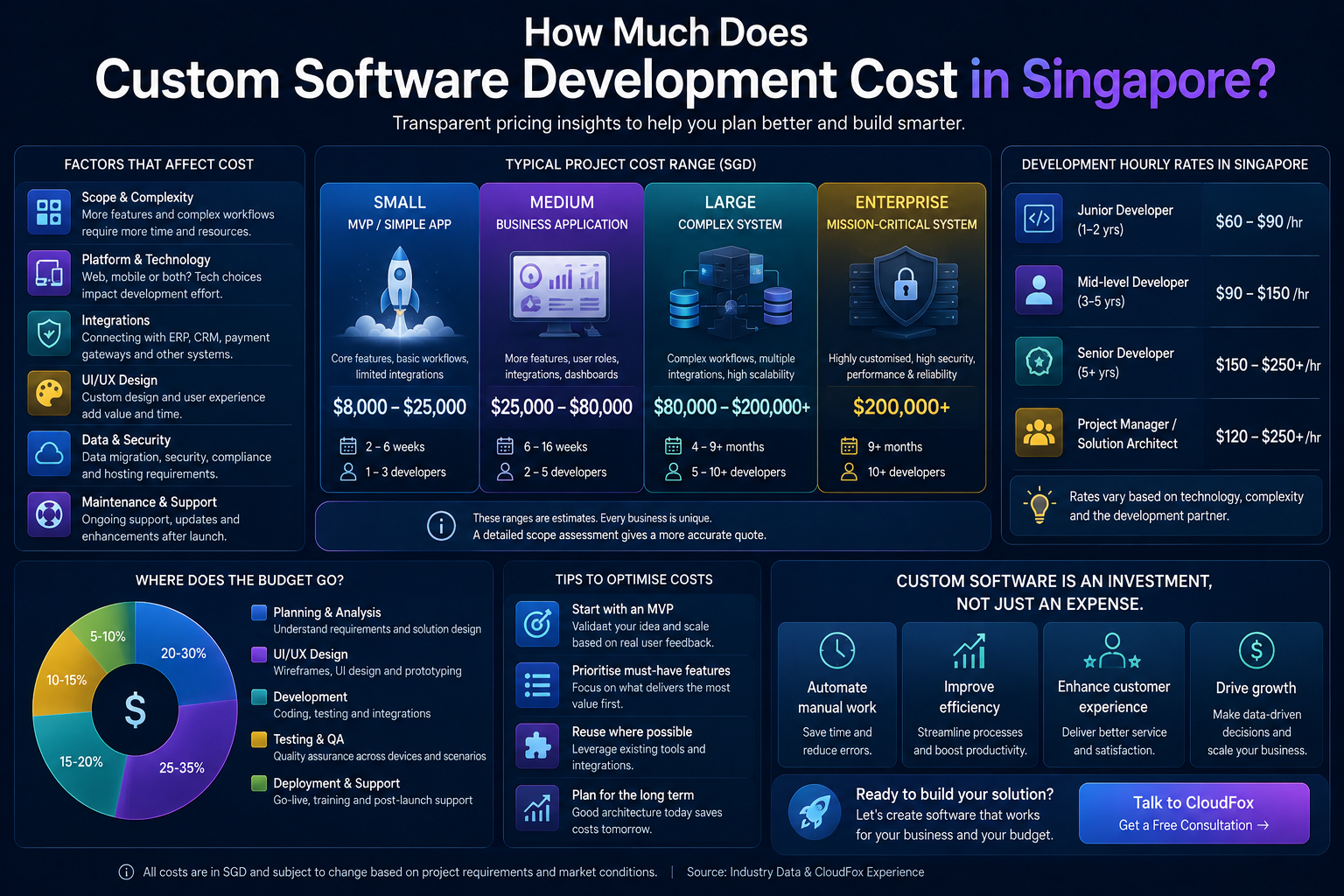
When Singapore businesses ask how much AI automation costs, they are usually looking for a budgeting range and a clear sense of what drives spend. There is no single market price that fits every company. Cost depends on the process you want to improve, how ready your data and systems are, and whether you need a focused pilot or a production capability that runs every day.
This guide explains the main cost factors so decision-makers can plan realistically — without treating AI as a fixed-price product.
What you are actually paying for
AI automation work is rarely just a model fee. Most projects combine process design, engineering, configuration, integration and change management. The visible “AI” piece is only one part of the investment.
- Mapping and redesigning the current workflow
- Building or configuring the automation layer
- Connecting ERP, CRM, email, document stores or internal systems
- Validation rules, exception handling and human approval steps
- Security, access control and operational monitoring
- Training teams and refining the process after launch
1. Workflow complexity
A narrow task — such as extracting fields from a consistent invoice format — is usually simpler than a multi-team process with exceptions, approvals and handoffs. Complexity rises when rules change by customer type, when documents vary widely, or when several departments must stay in the loop.
Practical signal: if two people in your team describe the same process differently, expect more discovery and design work before automation can be reliable.
2. Integrations with existing systems
Automation that only produces a spreadsheet is different from automation that writes into live business systems. Deeper ERP, CRM or accounting integrations typically raise both build and testing effort — and often deliver more operational value when done well.
For many enterprises, the right approach is to extend systems they already trust rather than replace them. See how CloudFox approaches AI automation alongside existing platforms.
3. Data readiness and document quality
Clean, structured inputs reduce build effort. Scanned PDFs, inconsistent templates, mixed formats or incomplete records increase validation work and human review. In Singapore SME environments, it is common to find critical information spread across email attachments, shared drives and messaging apps — which affects both timeline and cost.
4. Security, access control and governance
Projects that touch customer data, finance, HR or regulated documents need stronger access controls, audit trails and review paths. That does not mean every project must be heavyweight — but security requirements should be priced in from the start, not added as an afterthought.
5. Proof of concept versus production
A proof of concept may validate feasibility in a few weeks on a limited slice of work. A production rollout usually needs monitoring, support ownership, clearer exception handling and a durable operating model. Budgets should separate learning spend from production spend so stakeholders do not confuse a pilot with a finished capability.
6. Ongoing operating costs
After go-live, costs may include hosting, model or platform usage, monitoring, minor enhancements and process ownership. Teams sometimes under-budget this layer. Automation that saves operational hours still needs someone accountable for quality and exceptions.
Illustrative planning ranges — not market quotes
Exact figures vary widely. As a planning lens only — not a CloudFox price list or Singapore market average — teams often think in bands such as:
- Focused discovery or workflow assessment for one process
- Narrow pilot on a well-bounded use case with limited integrations
- Production automation for one high-volume workflow with system handoff
- Multi-process programmes with broader integration and governance
Treat these as conversation starters with your implementation partner. The right quote follows a review of process, systems and success criteria.
A practical way to budget
- Start with one high-volume, repetitive process and map the current steps.
- Define success in operational terms — time saved, fewer errors, faster turnaround or capacity unlocked.
- Separate discovery/pilot budget from production budget.
- Include integration, testing, security and change management — not only tool fees.
- Plan for iteration after launch; early automation almost always needs tuning.
When custom software affects the budget
If your workflow does not fit existing tools, part of the investment may go into custom software around the process rather than AI alone. Compare automation on current systems with broader business digitalisation or a custom build when fit is poor.
Questions worth asking before you buy
- Which process creates the most repetitive work today?
- Where must a human still approve or intervene?
- Which systems must the automation connect to?
- Is this a pilot to learn, or a production capability to run?
- Who will own the process after go-live?
The outcome that matters
Cost should be judged against operational value: less manual effort, more consistent handling, faster cycles and capacity for higher-value work. The right first project is usually the one with clear volume, clear rules and a measurable outcome — not the most ambitious AI idea.
If you want a practical assessment of an automation opportunity in Singapore, tell CloudFox about your current workflow and systems Talk to CloudFox.