Cost & Planning
How Much Does Custom Software Development Cost in Singapore?
What drives custom software budgets in Singapore — and how to plan scope without relying on unsupported market averages.
10 Aug 20269 min read
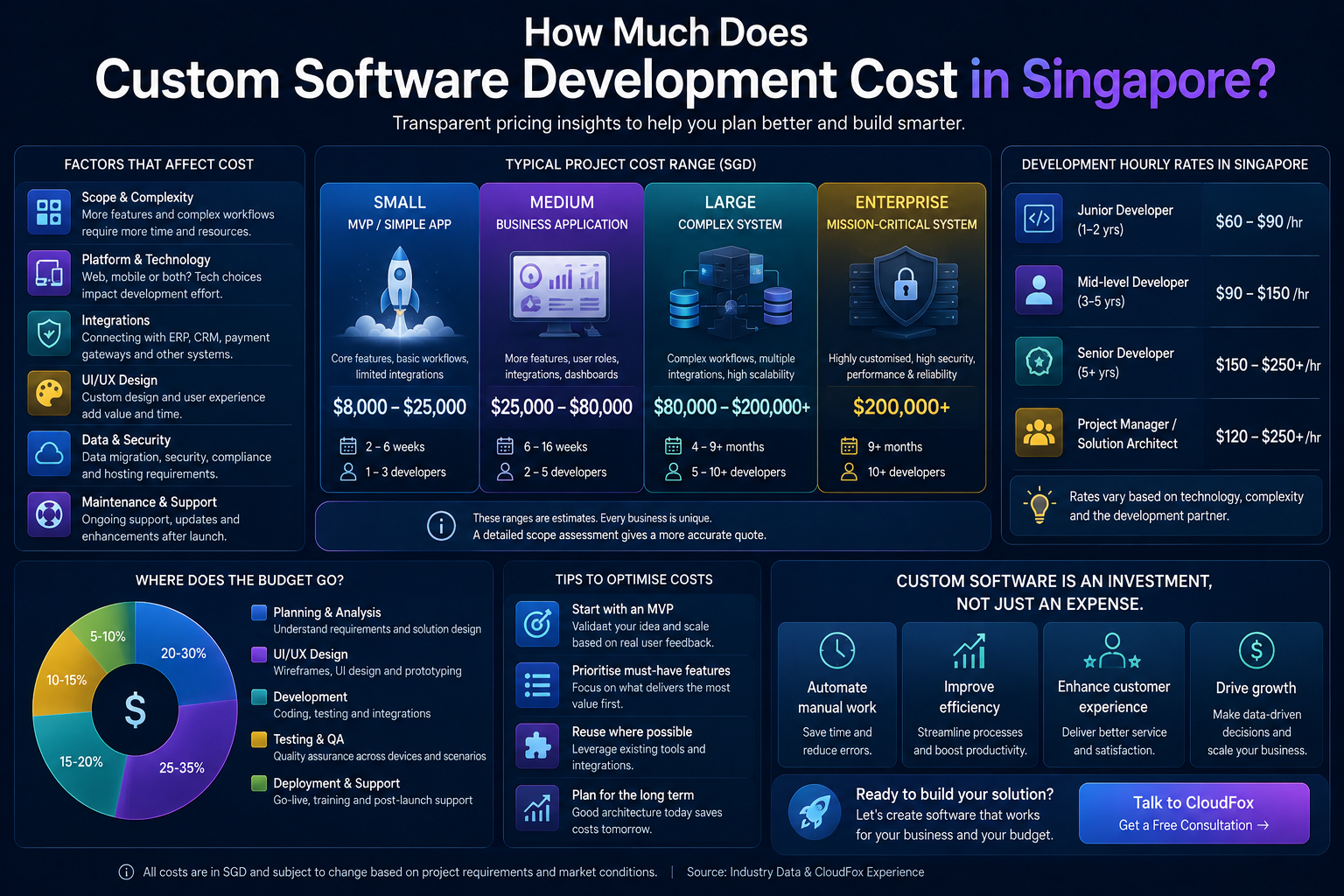
Custom software cost in Singapore varies because custom software varies. A focused internal workflow tool is not the same project as a multi-role operations platform with mobile access and deep ERP integration. Useful budgeting starts with cost drivers, not a single “market average.”
1. Scope
How many user roles, screens and process stages are in version one? Broader scope multiplies design, build and test effort. The most expensive habit is packing every future wish into the first release.
2. Workflow complexity
Simple CRUD applications cost less than systems with branching approvals, exception handling, SLA timers and role-specific rules. Complexity should be earned by operational need.
3. UI/UX requirements
Internal tools can be efficient without being flashy — but unclear interfaces create training cost and errors. Customer-facing portals usually need more design polish and accessibility care.
4. Integrations
Each connection to accounting, CRM, payment, identity or legacy systems adds analysis, engineering and testing. Integration is often where “simple app” estimates become real projects.
5. Mobile requirements
Responsive web may be enough. Native or field-ready mobile experiences add design, device testing and sometimes offline behaviour — plan for that explicitly.
6. Security and compliance expectations
Authentication, permissions, audit logs, encryption and environment separation are not optional extras for systems that touch customer or financial data. They belong in the budget from day one.
7. Data migration
Moving history out of spreadsheets or old tools can rival feature work. Cleaning duplicates and mapping fields is operational labour as much as technical labour.
8. Testing and quality assurance
Production software needs scenario testing, user acceptance and defect fixing time. Skipping this to “save cost” usually relocates cost into outages and rework.
9. Support and continuous improvement
After launch, budgets should cover monitoring, minor changes and support ownership. Software that supports operations is never fully finished on go-live day.
How to plan without false precision
- Write a one-page problem statement and success metrics
- Separate MVP scope from later phases
- List must-have integrations versus nice-to-haves
- Decide mobile needs explicitly
- Include migration, testing and support as line items
For related budgeting context, see our AI automation cost guide. When you are ready to scope a build, CloudFox custom software development focuses on workflow fit for Singapore businesses.
Illustrative planning note
Treat any public “average project cost” figures with caution unless you know the scope behind them. Two projects called “custom software” can differ by an order of magnitude. Ask partners to price against your workflow map, not a generic label.
Share the process you want to support and we can help outline a phased scope and cost drivers before you commit Talk to CloudFox.