Enterprise AI
What Is an Enterprise AI Knowledge Base and When Should You Use RAG?
When an AI knowledge layer helps employees find answers in company documents — and when a simpler approach is enough.
18 Aug 20269 min read
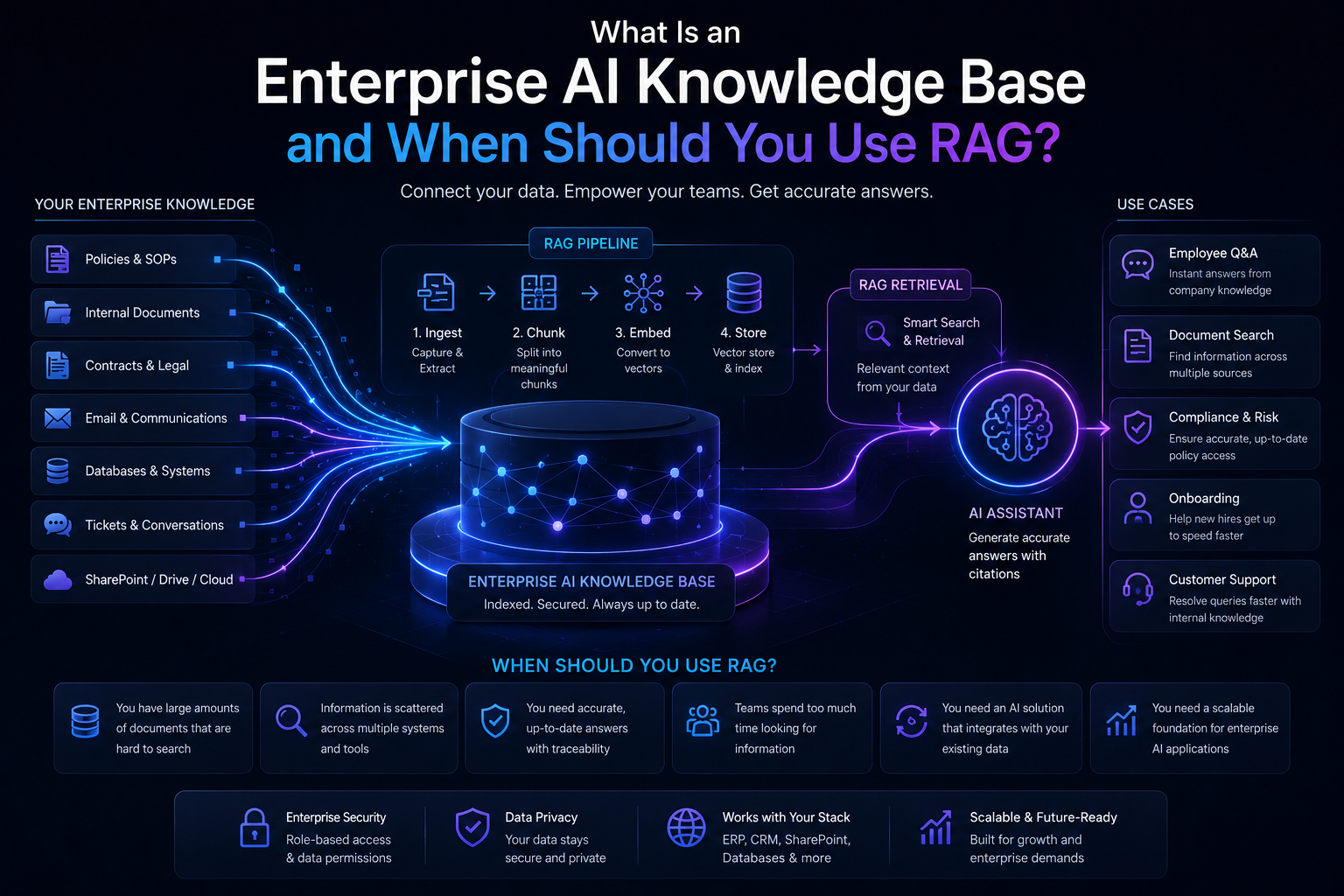
Employees waste hours hunting for the latest SOP, policy clause or contract template. An enterprise AI knowledge base aims to make internal documents searchable in plain language — while respecting permissions and source of truth.
What an enterprise AI knowledge base is
It is a controlled layer over your company content: policies, manuals, SOPs, product notes, contracts and approved FAQs. Staff ask questions in natural language and receive answers grounded in those documents, with references back to the source where possible.
What RAG means in plain language
RAG stands for retrieval-augmented generation. In business terms: before the AI answers, it first retrieves relevant passages from your approved documents, then uses those passages to shape the response. The point is grounding — reducing invented answers by tying output to material your organisation actually owns.
You do not need to memorise the acronym to use the capability. What matters is whether answers stay tied to current, permissioned sources.
When this approach helps
- Large volumes of internal documents staff must consult often
- Onboarding that currently depends on “ask a senior colleague”
- Policy and procedure questions that should cite approved text
- Support teams that repeat the same knowledge lookups daily
When it is the wrong first project
- Documents are outdated, duplicated or contradictory
- Access control is unclear and sensitive files are mixed in
- The real problem is a broken workflow, not search
- There is no owner to keep content current after launch
Business prerequisites that matter more than models
- Decide which document sets are in scope
- Clean obvious duplicates and expired versions
- Preserve existing permission boundaries
- Define what the assistant must refuse to answer
- Assign content ownership after go-live
Enterprise AI knowledge work sits alongside broader CloudFox services — from AI automation to custom software that houses operational knowledge in structured systems.
Human oversight still belongs in the design
For compliance, legal interpretation or customer commitments, AI should help people find and prepare information — not silently replace accountable judgement. Pair knowledge assistants with clear escalation paths.
A practical evaluation question
Ask: if this assistant disappeared tomorrow, would staff lose a faster way to find approved answers — or would nothing change because the documents themselves are unusable? Fix the knowledge foundation first when the answer is the latter.
If your teams spend too long searching internal documents, we can help assess whether an AI knowledge layer is the right move Talk to CloudFox.